Momoe Yamaguchi

  • Cosmos (秋桜) by Momoe Yamaguchi: A Gentle Autumn Song for the Flowers in My Garden

    In autumn, soft pink cosmos flowers begin to sway in my garden. Every year, when I see them, this is the song that comes to my mind.

    The song

    “Cosmos (秋桜)” is a song by Momoe Yamaguchi, released in 1977. It was written and composed by Masashi Sada, a singer-songwriter known for his gentle, story-like songs. The title uses the characters for “autumn” and “cherry blossom,” and they are read as “cosmos.” I learned how to write the word this way from this very song.

    Why I chose it

    This is not city pop, and it is not an 80s idol song. It is a quiet idol ballad from the late 1970s. Still, I wanted to share it because it shows another soft side of Showa music: a calm autumn day, a gentle melody, and feelings that are not spoken out loud.

    What I remember

    The cosmos in my garden bloom every autumn, and when they do, I think of this song. The flowers are delicate, but they keep swaying in the wind and stand tall.
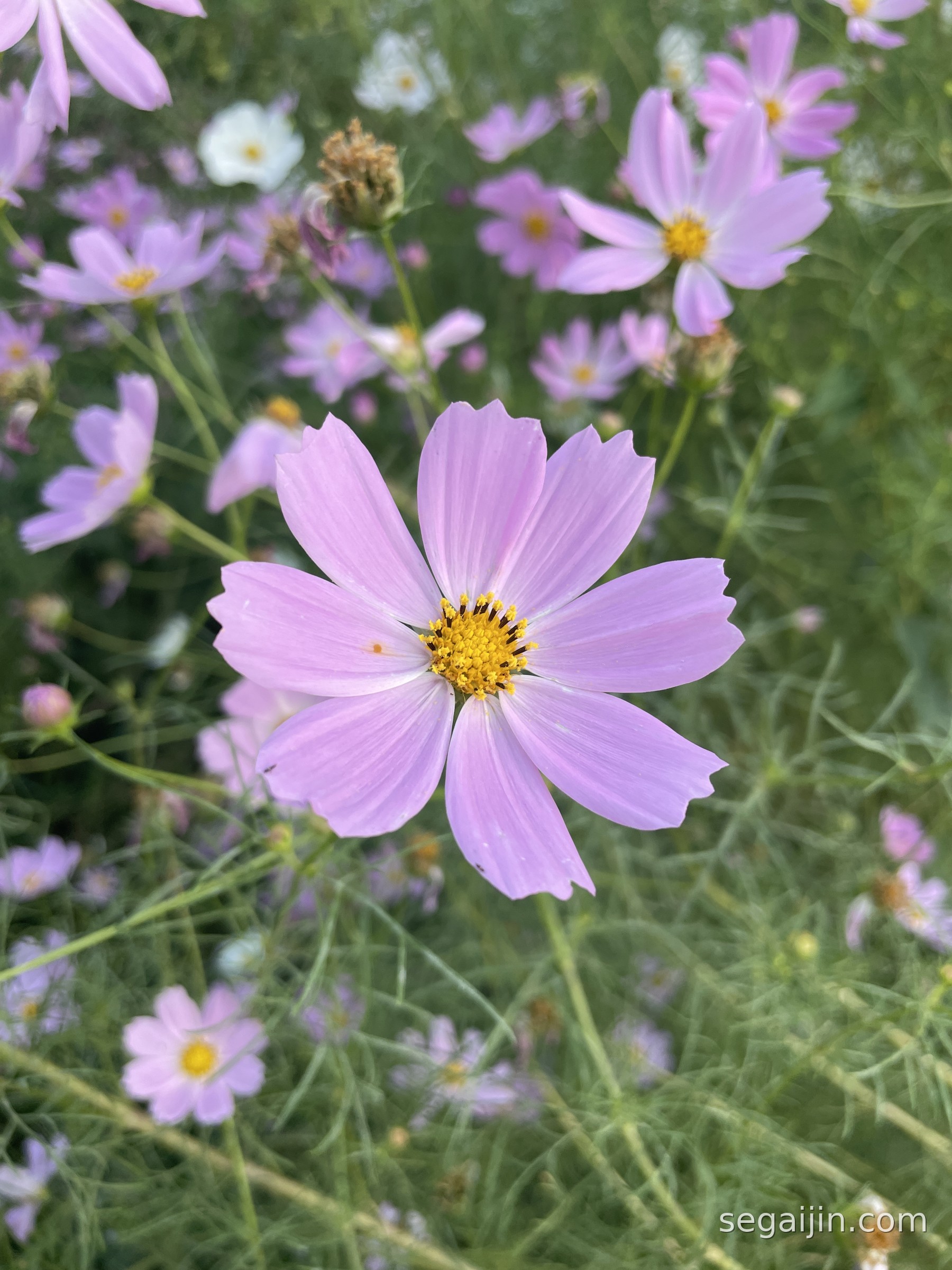
    A soft pink cosmos flower in the garden
    Cosmos blooming in my garden. I wonder if this is what the color “usubeni” looks like? Photo: Segaijin

    The song begins with a color: “usubeni,” a pale crimson, a soft pink with a little red in it. When I first heard that word, I thought, what a graceful way to describe this color. It sounds so grown-up and so gentle. And the way the flower is written, “autumn cherry blossom,” shows such beautiful taste. They really do look like cherry blossoms of autumn.

    There are cosmos in many colors. Yellow and orange ones, called “kiba-na cosmos” (yellow cosmos), bloom in Japan too, and they are lovely. But for this song, I always picture cosmos in exactly this soft pink.

    The song follows a daughter on the day before her wedding, quietly looking at her mother and the time they have shared. The whole song feels like a warm, quiet autumn afternoon.

    By the way, I am a great fan of Masashi Sada, the writer of this song. Every year, I look forward to his programs on NHK around the end of the year and the New Year holidays. His gentle words and melodies feel like a warm light in the middle of winter. Perhaps that is why this song, written by him, stays so close to my heart in autumn.

    Listen

    Here is the song on Spotify:

    If you would like to hear more of her songs on CD, CDJapan ships Momoe Yamaguchi’s complete singles collection worldwide (affiliate link).

    Is there a song that makes you think of a flower or a season where you live?

  • Ii Hi Tabidachi (いい日旅立ち) by Momoe Yamaguchi: The Song Written to Make You Take a Train

    Some songs are written for a movie. Some are written for a drama. This one was written to make people take a train.

    In November 1978, Japanese National Railways launched a travel campaign called “Ii Hi Tabidachi” (いい日旅立ち, “A Good Day to Set Out on a Journey”). Its theme song, sung by Momoe Yamaguchi, became one of the most loved songs in Japan.

    Bright blue sky with white clouds, the feeling of a journey beginning
    Blue sky, ready to go. Photo: Segaijin

    The song

    “Ii Hi Tabidachi” (いい日旅立ち) was released on November 21, 1978, as Momoe Yamaguchi’s 24th single. Shinji Tanimura wrote both the lyrics and the music. It was the first time he wrote one of her singles. The song reached #3 on the Oricon chart. According to Oricon, it sold about 536,000 copies, and the record company reports a total of one million.

    Japanese National Railways, often called JNR, is the predecessor of today’s JR. The campaign was made to invite people to travel around Japan by train. The title is said to come from the first letters of two companies that supported the campaign, Nippon Travel Agency (日本旅行) and Hitachi (日立).

    A song for weddings and graduations

    Today, many people sing it at weddings and graduations. Interestingly, Tanimura himself said that the content is not really suited for celebrations. It is a song about leaving, after all. In 2007, it was chosen as one of “Japan’s 100 Songs” (日本の歌百選). Even now, it is played when special JR revival trains leave the station.

    Why I love Momoe’s version

    I like both versions: Momoe Yamaguchi’s, and the one by Shinji Tanimura, who wrote the song. But for me, hers is the one that sounds like travel.

    Her version opens with an introduction that makes you want to travel. Before she even starts singing, you can feel the train leaving the station. I also love her voice in the line where she sings about “somewhere in Japan.”

    What are “sheep clouds”?

    One word in the song stays with me: hitsujigumo (羊雲). It means “sheep clouds.” These are small, round, fluffy clouds that spread across the sky like a flock of sheep, and you often see them in autumn. I love the image of going out to look for them. It is such a gentle reason to take a trip.

    As a kid, I had no idea what hitsujigumo was. I remember looking it up. It is a cloud I still love today. Whenever I see hitsujigumo, I think of this song. And the best part is that the sky is the same in every country. Wherever you are in the world, you can look up and see the same clouds.

    Back then, and still today, I think the same thing every time I hear it: what a truly good song.

    Listen

    Compare the two versions on Spotify:

    Want to own the song? Momoe Yamaguchi’s complete singles collection at CDJapan includes “Ii Hi Tabidachi” (disc 2, track 6). This is an affiliate link. If you buy through it, I may earn a small commission at no extra cost to you.

    And a book about her (CDJapan, affiliate link):

    And a concert video (CDJapan, affiliate link):

    Which one makes you want to travel? Tell me in the comments. And if you have ever looked up at the sky in Japan and seen hitsujigumo, I would love to hear about it.

    This is part of my series: one Showa-era song a day, with a focus on the 80s.